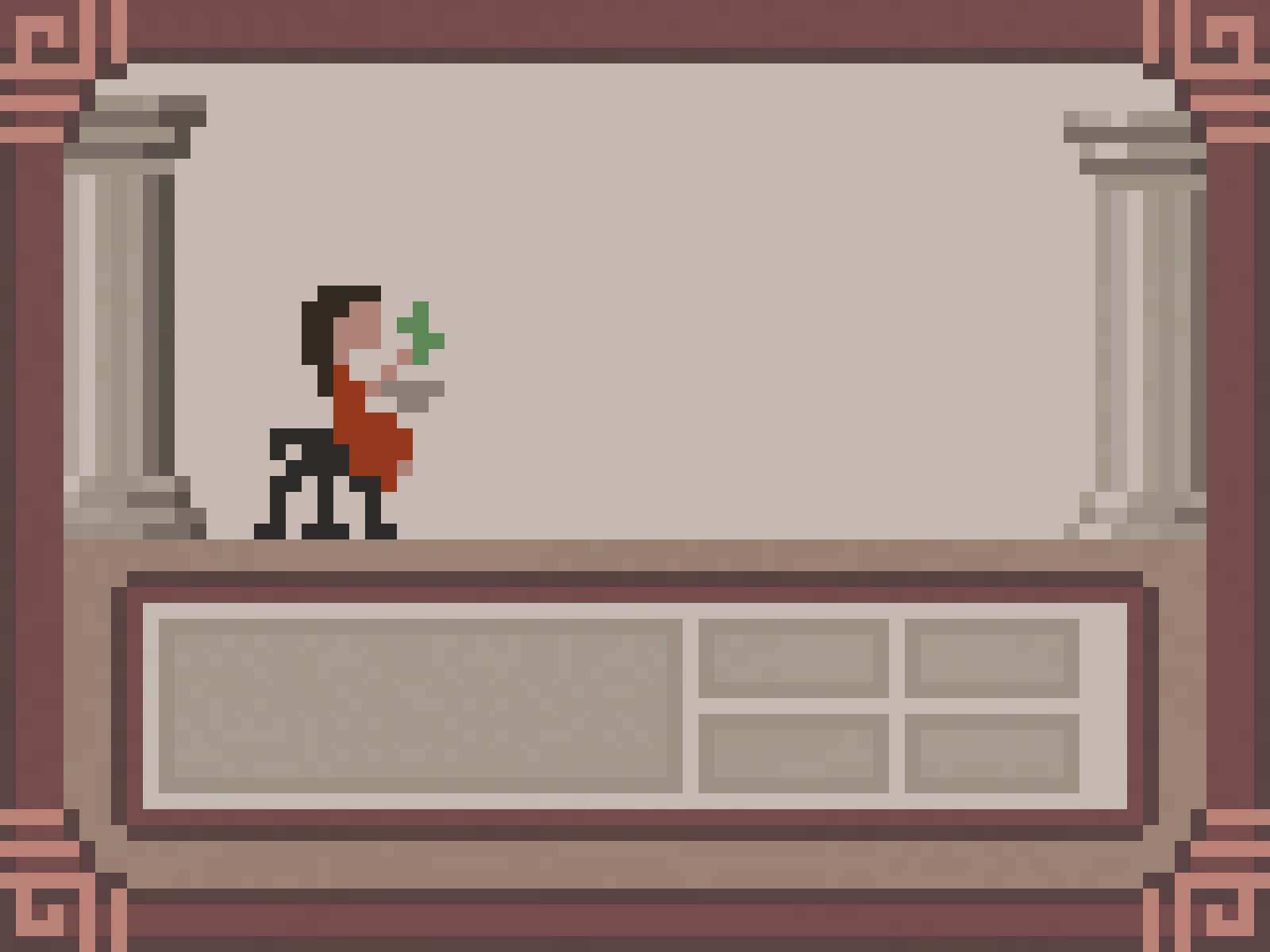
Plato
Plato asks about how to spread his wisdom, through conversation, or through the written word. He also asks about
the greatest good that a mortal can achieve, and how justice can be defined.

Process
Software Development
For version control and organization, I used Github. The backend is typescript and the frontend is react. I used
jest for unit testing. The readme includes instructions for running locally if that is of interest.
Github Repo
Research and Content Development
My main source for research was lecture and course material from PHIL 211 2024w1 with Dr. Michael Griffin. I consulted my notes taken in class, lecture
slides, and the reading guides for Plato. I also watched some videos on the Oracle of Delphi for inspiration. I found
it very interesting to review the course material with a question and answer format in mind. Given more time over the
next couple of months, I will certainly be adding more content to fill out the game.
Future Development
I. The God Apollo
Interaction with the God, the God somehow communicates with the Pythia, encouraging certain answers over others.
II. Piousness
Maintain a Piousness bar, the closer your insights align with the God Apollo, the better your piousness status.
The goal of the game would then be to maximize piousness. For example, if you answer the philosophers questions
with the answers that they would come to believe themselves, your piousness will increase.
III. Added Content
The questions and seekers are represented as json files, so are very easy to update. New content can be added simply
by swapping the resource file for something more robust.
IV. General Beautification
Gentler transitions, more and improved art, smoother entrance to the game.
Sources
“Delphic Philosophy 3: From Palace to Polis.” Michael Griffin, last edited [Unknown]. Accessed 15 Dec. 2024.
https://docs.google.com/document/d/1b7_ILb60ooRsb1Jq3AkRP9PB7sTrzq2qFiwTi2XBUeA/edit.
Kaz Rowe. (2024, February 16). So What WAS the Deal with the Oracle of Delphi?. YouTube.
https://www.youtube.com/watch?v=VuGRoHgVELk
Salt, Alun, and Efrosyni Boutsikas. “Knowing When to Consult the Oracle at Delphi.” Antiquity 79.305 (2005):
564–572. Web.